How to Structure an Olympic Weightlifting Competition Cycle
From Retention to the Platform: Building Performance That Holds Up on Competition Day
A weightlifting program can look successful for weeks and still fail to produce the performance an athlete expects on competition day.
• The athlete may get stronger
• Training numbers may improve
• Heavy singles may appear at the right time
Yet as competition approaches, something begins to change.
• Snatches become less repeatable
• Clean & jerks that were previously stable become unpredictable
• Heavy attempts require more recovery
• Technical consistency declines under increasing load.
The athlete may still be capable of producing a good lift, but that performance becomes harder to reproduce.
Peak performance establishes capability, but repeated and changing exposures reveal performance behavior.
The question is not simply whether an athlete can lift more, but whether the qualities developed earlier in the training cycle remain available as the demands of training change.
That idea is central to how I approach Olympic weightlifting development and ultimately became the foundation of the EVZ Olympic Weightlifting Development System.
⸻
Competition Preparation Is More Than Getting Stronger
Traditional weightlifting periodization already recognizes that training should change as competition approaches.
Preparatory periods generally include greater volume and exercise variety, while competitive phases move toward greater specificity, heavier loading, fewer repetitions, and greater emphasis on the competition lifts.
Research in competitive weightlifters also suggests that simply accumulating more very-high-intensity volume is not automatically better.
In one 10-week study of experienced weightlifters, moderate volumes of high-relative-intensity training produced greater improvements than either lower or substantially higher volumes, while athletes assigned the highest volume struggled to complete all prescribed repetitions above 90% of 1RM.
That reinforces a practical reality:
• More exposure does not necessarily mean better preparation
The challenge is organizing enough training to create adaptation without adding volume simply as insurance.
This becomes increasingly important as competition approaches, because fatigue and accumulated training load can interfere with performance expression. Longitudinal research across athletic populations has repeatedly shown that training load and fatigue need to be managed across time rather than interpreted from isolated sessions.
For weightlifters, the goal is therefore not merely to accumulate fitness, but to arrive at competition with the qualities developed throughout the cycle still accessible.
⸻
Where Programs Can Break Down
A common programming assumption is that if an athlete develops a quality during one block, that quality remains available while the next quality is developed.
In practice, that is not always what happens.
• An athlete might establish technically consistent snatches at moderate loads, then lose that consistency when loading rises.
• A lifter may demonstrate excellent strength development but struggle to express that strength in the competition lifts.
• Heavy singles may improve, but repeatability around those singles may deteriorate.
• Or an athlete may intentionally reduce demand during a deload or transition period and then struggle to recover previously demonstrated performance quickly.
None of these situations necessarily means the program failed, but they do reveal different developmental problems.
This is where I find it useful to think about weightlifting preparation through a sequence of developmental questions rather than only through increasing percentages.
⸻
1. Retention: Can Performance Become Repeatable?
The first question is:
• Can the athlete reliably reproduce what has already been established?
Retention is not about chasing the highest lift possible, but establishing stable, repeatable performance before demanding more from it.
Within the broader Evans Velo Zone® framework, Retention examines whether established performance remains sufficiently stable across repeated exposures.
In Olympic weightlifting, this might mean evaluating whether an athlete can repeatedly:
• Establish the same receiving position
• Maintain bar proximity
• Preserve timing through multiple working sets
• Reproduce technically acceptable lifts at a given load
• Maintain intended output without rapid deterioration
This does not mean every repetition must be identical, instead performance becomes reliable enough that increasing demand is justified.
That distinction becomes important because one successful lift can tell us what the athlete can do, but repeated successful lifts tell us more about what the athlete has actually established.
This concept also underlies the logic behind the Retainable Power Index (RPI™), which evaluates how well performance holds across repeated exposures rather than relying solely on the best output.
⸻
2. Transfer: Does Performance Hold When Demand Changes?
Once performance becomes sufficiently stable, the next question is:
• Can the athlete carry that performance into more demanding conditions?
In weightlifting, increasing demand may include:
• Greater load
• More competition-specific variations
• Reduced assistance
• Increasingly difficult positional requirements
• Greater reliance on the full competition lifts
• Higher technical consequences for small errors
A lifter moving from 70% to 80% should not necessarily move the bar with identical velocity or experience identical difficulty.
The important question is whether the relevant performance quality remains available as demand changes.
That is Transfer and the broader EVZ framework defines Transfer around the ability to preserve established performance across changing demands.
This matters in weightlifting because technically excellent work at moderate intensity has limited competition value if it disappears every time the bar becomes heavy.
Transfer provides the bridge between:
• “I can do this consistently.”
and:
• “I can still do this when the task becomes harder.”
⸻
3. Re-attainment: Can Performance Be Restored After Demand and Fatigue?
Weightlifting performance is rarely expressed in a perfectly fresh state.
Across a training session, and especially during competition, athletes accumulate physical and technical demand as attempts become heavier. The ability to produce a strong lift early does not necessarily tell us how well that performance will remain available after repeated exposures.
This creates an important question:
• After performance has been challenged by increasing demand and accumulated fatigue, can the athlete restore what was previously established?
That is the role of Re-attainment.
Within Evans Velo Zone®, Re-attainment refers to restoring previously established output after conditions have changed. The EVZ Wave™ provides a structured way to evaluate this by organizing performance into:
• Wave 1 → Reset → Wave 2
Wave 1 progresses through increasing levels of demand, allowing the athlete to establish a performance profile while fatigue and task difficulty accumulate. After a defined reset, Wave 2 repeats compatible demands so the practitioner can evaluate how effectively the athlete re-establishes the performance demonstrated earlier.
The purpose is not simply to ask whether the athlete performs better or worse in Wave 2.
Instead it is to ask:
• How much of the previously established performance remains accessible after the athlete has already been exposed to meaningful demand?
This makes the Wave structure particularly relevant to Olympic weightlifting, where competition itself follows an escalating attempt pattern. Athletes warm up progressively, take increasingly demanding lifts, recover for relatively short periods, and then must reproduce high-quality performance again under greater consequence.
The Wave is not intended to replicate a competition exactly. Instead, it creates a competition-relevant loading rhythm:
• Build demand → accumulate stress → reset → re-establish performance
That provides a controlled way to observe whether the athlete can restore technical quality, output, and repeatability after performance has already been challenged.
A temporary reduction in performance is therefore not automatically a failure.
If the protocol is valid, the relationship between Wave 1 and Wave 2 becomes the developmental finding:
• Progress when previously established performance is restored or exceeded
• Hold when performance approaches restoration but is not yet sufficiently re-established
• Fade when previously established performance meaningfully deteriorates
• Stall when a productive performance profile fails to establish
That distinction becomes increasingly valuable as the athlete moves toward heavier singles and eventually the competition platform.
The goal is not to arrive at competition having demonstrated one isolated peak, but to arrive with evidence that performance can be re-established after increasing demand, when the athlete is no longer operating under perfectly fresh conditions.
⸻
4. Output: Can Higher Performance Become Repeatable?
Eventually, training has to move beyond stability.
The athlete needs to produce more.
But I do not view Output as simply:
• Lift the heaviest weight possible
The more useful question is:
• Can the athlete repeatedly express higher competition-relevant performance?
Output therefore sits on top of the qualities developed earlier.
The athlete is not abandoning Retention or Transfer in order to chase a peak.
The objective is to increase expression while preserving enough stability that the new level of performance becomes usable.
This is where the difference between peak output and repeatable high output becomes particularly important.
A single excellent 120 kg snatch tells us that 120 kg was available once.
Multiple high-quality exposures around that level tell us considerably more about competition readiness.
That is why I view heavy training as an expression problem as much as a strength problem.
⸻
5. Heavy Singles: Own the Performance Before Competition
Heavy singles deserve their own place in the weightlifting sequence.
By this stage, the primary objective is no longer broad development, but ownership.
The athlete needs repeated exposure to increasingly competition-relevant loading while minimizing unnecessary fatigue.
This is where minimum-effective-volume thinking becomes especially valuable.
Research in trained weightlifters suggests that excessive high-intensity volume is not necessarily advantageous, and substantially higher exposure above 90% may become difficult to complete productively.
The objective should therefore not be:
• How much heavy work can the athlete survive?
It should be:
• What is the minimum amount of high-quality heavy exposure needed to establish confidence and readiness?
That is an important distinction because heavy singles should clarify performance, not bury it under fatigue.
⸻
6. Competition: Express What Has Been Built
Competition is not another developmental block, but the expression point.
By this stage, the athlete should not be trying to create major new adaptations.
The priority becomes reducing unnecessary fatigue while preserving readiness and technical familiarity.
Tapering is nearly universal among competitive weightlifters. In a survey of competitive athletes, 99% reported using a taper, with an average duration of approximately eight days and an average training-volume reduction of about 43%.
A recent systematic review across weight-lifting sports similarly found that tapering commonly lasts approximately five to nine days, with training volume typically reduced by roughly 40–45% and peak intensity often occurring two to three weeks before competition.
The exact taper should still reflect the athlete, but the underlying principle is consistent:
• Competition preparation eventually has to move from development toward expression
⸻
The Sequence I Use
This leads to the weightlifting-specific developmental sequence I use:
• Retention → Transfer → Re-attainment → Output → Heavy Singles → Competition
Each phase answers a different question.
Retention
• Can the athlete establish repeatable performance?
Transfer
• Can that performance survive increasing demand?
Re-attainment
• Can previously established performance be restored?
Output
• Can higher performance become repeatable?
Heavy Singles
• Can the athlete own increasingly competition-relevant loading?
Competition
• Can the athlete express the highest available performance when it matters?
This sequence forms the programming architecture of the EVZ Olympic Weightlifting Development System.
Importantly, it does not require one rigid list of exercises.
The framework establishes the developmental purpose and exercise selection can remain flexible within appropriate guardrails.
⸻
Why I Built It Around Three Days Per Week
Another assumption I wanted to challenge was that serious Olympic weightlifting development automatically requires five or six lifting sessions every week.
Higher frequency can certainly be appropriate, but it is not the only viable structure.
For many competitive, Masters, recreational, and multi-sport athletes, recovery capacity and available training time are finite.
Three focused Olympic weightlifting sessions can provide enough exposure to drive meaningful development while leaving room for recovery, complementary strength work, another sport, and life outside the gym.
The important variable is not how many days appear on the calendar, but whether each session has a clear developmental purpose.
That is why the EVZ Olympic Weightlifting Development System is built around a three-day core structure rather than treating lower frequency as a compromise.
⸻
Applying These Principles in My Own Competition Preparation
These ideas were not developed only as an abstract programming model.
I have also applied them within my own Olympic weightlifting preparation.
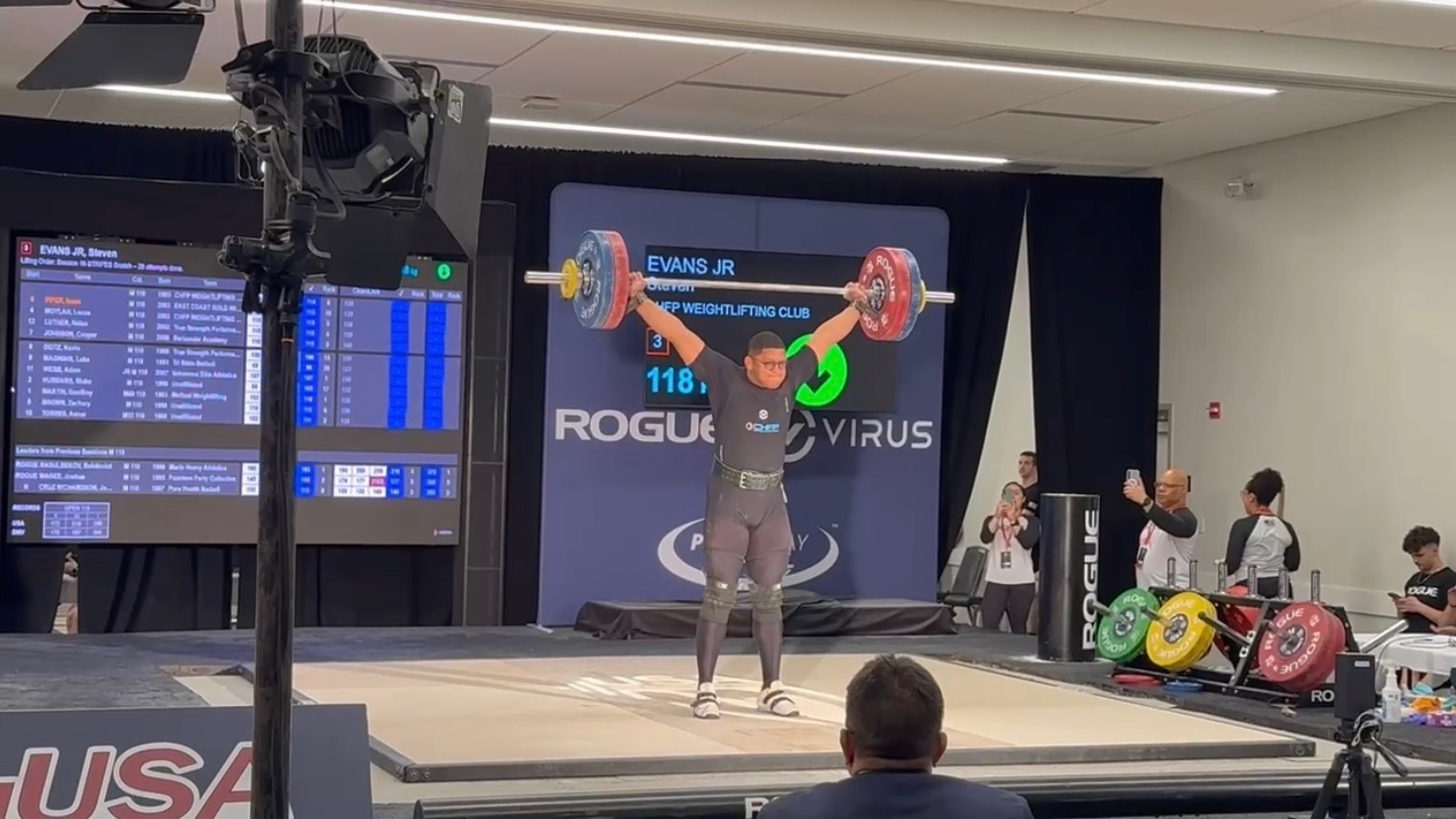
In one recent competition, I went 6-for-6, producing competition PRs in both lifts:
• 118 kg Snatch
• 140 kg Clean & Jerk
I do not view one successful competition as proof that a methodology caused the outcome. Instead, it is better viewed as an applied example of the principles.
Throughout preparation, I was interested not simply in whether heavier numbers appeared in training, but whether performance became stable enough to trust.
That included repeated exposure to heavy singles and deliberate management of workload as competition approached.
For me, that is the larger lesson:
• Competition confidence should come from evidence accumulated before meet day.
Not from hoping the athlete’s best performance appears at the right moment.
⸻
What Coaches and Lifters Can Take From This
You do not need to use EVZ to ask better questions about your weightlifting program.
Look at your current cycle and ask:
• What qualities have actually become stable?
• What disappears when loading increases?
• Are heavy lifts becoming more repeatable or simply heavier?
• What previously established performance needs to be restored?
• Is training volume still contributing to development, or simply adding fatigue?
• Is the final phase of the cycle developing more fitness or preparing the athlete to express what has already been built?
Those questions shift programming away from simply completing weeks and percentages and move the focus toward developmental behavior over time.
That is also the broader idea behind Evans Velo Zone®:
• Measurement becomes more useful when it contributes to a developmental decision rather than existing as an isolated result.
For a deeper discussion of that principle, see The Next Frontier in Performance Technology Isn’t More Data, It’s Retention.
⸻
A Complete Competition-Cycle Structure
I built the EVZ™ Olympic Weightlifting Development System to translate these ideas into an actual programming structure.
It includes:
• A complete three-day weekly training structure
• Competition and developmental macrocycle organization
• Phase-specific programming guidance
• Governed exercise substitutions
• Training-max inputs and adaptive prescriptions
• Training logs and quality tracking
• Competition preparation and taper structure
The goal is not to remove coaching judgment, but to give coaches and athletes a clearer framework for organizing that judgment across the entire competition cycle.
Framework-driven. Exercise-flexible. Competition-focused.
Explore the EVZ Olympic Weightlifting Development System
⸻
Final Thought
Weightlifting programming should do more than create higher numbers in training.
It should progressively answer:
• Can the athlete establish performance?
• Can they carry it into greater demand?
• Can they restore it when it changes?
• Can they repeatedly express it at a higher level?
• Can they own it under heavy loading?
And ultimately:
• Can they express it on competition day?
A peak tells us what was possible, but a well-constructed training cycle should give us increasing evidence that the performance will still be there when it matters.
⸻
References
• González-Badillo, J. J., Gorostiaga, E. M., Arellano, R., & Izquierdo, M. (2006). Moderate volume of high relative training intensity produces greater strength gains compared with low and high volumes in competitive weightlifters. Journal of Strength and Conditioning Research, 20(1), 73–81.
• Winwood, P. W., Keogh, J. W. L., Travis, S. K., & Pritchard, H. J. (2023). The tapering practices of competitive weightlifters. Journal of Strength and Conditioning Research, 37(4), 829–839.
• Travis, S. K., et al. (2026). Tapering and peaking in the weight lifting sports: A systematic review of athletes’ self-reported strategies. Sports Medicine.
• Travis, S. K., Mujika, I., Gentles, J. A., Stone, M. H., & Bazyler, C. D. (2020). Tapering and peaking maximal strength for powerlifting performance: A review. Sports, 8(9), 125.
• Jones, C. M., Griffiths, P. C., & Mellalieu, S. D. (2017). Training load and fatigue marker associations with injury and illness: A systematic review of longitudinal studies. Sports Medicine, 47, 943–974.
• Hornsby, W. G., et al. (2019). Phase-specific changes in rate of force development and muscle morphology throughout a block periodized training cycle in weightlifters. Sports.
• Evans, S. Jr. What Is Evans Velo Zone®? A Developmental Framework for Building Durable Athletic Performance. Evans Performance®.
• Evans, S. Jr. The Next Frontier in Performance Technology Isn’t More Data — It’s Retention. Evans Performance®.
• Evans, S. Jr. Understanding the Retainable Power Index (RPI™). Evans Performance®.
• Evans, S. Jr. EVZ™ Olympic Weightlifting Development System. Evans Performance®.