Readiness Is Not Retention: The Missing Layer in Performance Technology
Today's Performance Tech
Performance technology has become extremely good at telling us what an athlete can do today.
Force plates, velocity-based training systems, jump testing, heart-rate measures, wellness questionnaires, and other monitoring tools can give practitioners increasingly detailed information about an athlete’s current state.
Athlete monitoring research has expanded considerably around the measurement of training response, fatigue, recovery, readiness, and performance status (Saw et al., 2016; Burger et al., 2024). PubMed
That information is valuable, but it does not fully answer another question that may matter just as much:
• What has the athlete actually retained?
Readiness and retention are not the same thing
Readiness is generally concerned with the athlete’s current state and their ability to perform or tolerate training at a given point in time.
Practitioners may infer that state through subjective wellness measures, neuromuscular testing, physiological markers, or combinations of multiple monitoring methods.
Research also shows that different monitoring measures do not always tell the same story, reinforcing the importance of interpreting athlete status within context rather than relying on a single metric (Saw et al., 2016). PubMed
Retention asks a different question.
It is concerned with the durability of an adaptation.
• What happens when exposure to a particular quality is reduced?
• What happens when the training phase changes?
• When fatigue increases?
• When another developmental priority takes its place?
• Does the quality remain available?
Research on detraining demonstrates that physiological and performance adaptations do not all disappear at the same rate when training stimulus is reduced or removed.
Some capacities decline relatively quickly, while others can persist considerably longer depending on the quality, athlete, training history, and remaining stimulus (Mujika & Padilla, 2000a, 2000b; Bosquet et al., 2013). PubMed
That makes retention a different developmental question from readiness.
Temporary expression is not necessarily durable adaptation
A strong result tells us what happened at a particular moment.
• A jump improves.
• Bar velocity increases.
• A strength test moves upward.
• An athlete performs well during a highly specific training phase.
Those outcomes matter, but they do not necessarily tell us how durable the underlying adaptation has become.
The literature on training cessation illustrates this clearly.
Strength, power, aerobic capacity, and other training-induced adaptations can decay at different rates when sufficient training stimulus is withdrawn.
For example, a systematic review in elite collision-sport athletes found different retention and decay patterns for strength and power, while broader detraining research has shown that some aerobic and physiological adaptations can begin declining within weeks of reduced training exposure (McMaster et al., 2013; Mujika & Padilla, 2000a). PubMed
So a temporary expression of performance and a durable adaptation should not automatically be treated as equivalent.
The more useful question may be:
• What happens to that quality over time?
Does it:
• persist?
• decay rapidly?
• remain relatively stable with less exposure?
• return quickly when reintroduced?
Those patterns can add information that an isolated test cannot provide.
We may not need more data
The performance field does not appear to have a shortage of measurement.
Modern athlete-monitoring systems can integrate external load, internal load, physiological data, subjective wellness, testing results, and other performance indicators.
Recent literature has increasingly emphasized not simply collecting those measures, but interpreting them in context and connecting them to actionable decisions (Leduc & Weaving, 2025; Burger et al., 2024). PubMed
That distinction is important.
More information does not automatically produce a better decision.
The harder questions are often:
• What persisted?
• What decayed?
• What needs to be revisited?
• What should we do next?
The value of performance technology should not end with measurement.
Its practical value increases when measurement helps improve the decision that follows.
From snapshots to longitudinal understanding
A single assessment gives us a snapshot.
Monitoring gives us the opportunity to observe change.
Those are fundamentally different uses of information.
Contemporary athlete-monitoring literature increasingly distinguishes isolated assessment from repeated measurement used to understand training response over time.
Longitudinal interpretation can provide context that a single score cannot: what preceded the result, how the athlete responded, whether the change persisted, and how the athlete behaves across different training environments. PubMed
This matters because athlete development is not a collection of disconnected tests.
It is a process occurring across training blocks, competitions, periods of reduced exposure, fatigue, recovery, and changes in developmental emphasis.
A test result becomes more informative when we know:
• What preceded it?
• What training stimulus produced it?
• What happened when that stimulus was reduced?
• And what remained afterward?
That is the difference between simply recording performance and beginning to understand the behavior of an adaptation.
Retention changes the developmental conversation
Once retention becomes part of the conversation, testing can serve a broader purpose.
Instead of asking only whether a number improved, practitioners can begin asking what happened to that quality afterward.
For example:
• If a quality persists despite reduced exposure, it may require less developmental emphasis.
• If it decays quickly, the athlete may require more frequent or strategically placed exposure.
• If it returns quickly after reintroduction, that pattern may provide useful information about how the athlete responds to re-attainment.
• If several qualities deteriorate simultaneously, the practitioner may need to investigate the broader context rather than treating each result as an isolated problem.
The broader research literature supports the premise that adaptations differ in how they respond to maintenance, reduced training, and detraining.
Reduced training can preserve certain adaptations when sufficient intensity or stimulus is maintained, whereas complete cessation tends to produce greater losses over time (Hickson & Rosenkoetter, 1981; Mujika & Padilla, 2000b). PubMed
The test may be the same, but the interpretation changes.
From measurement to decision
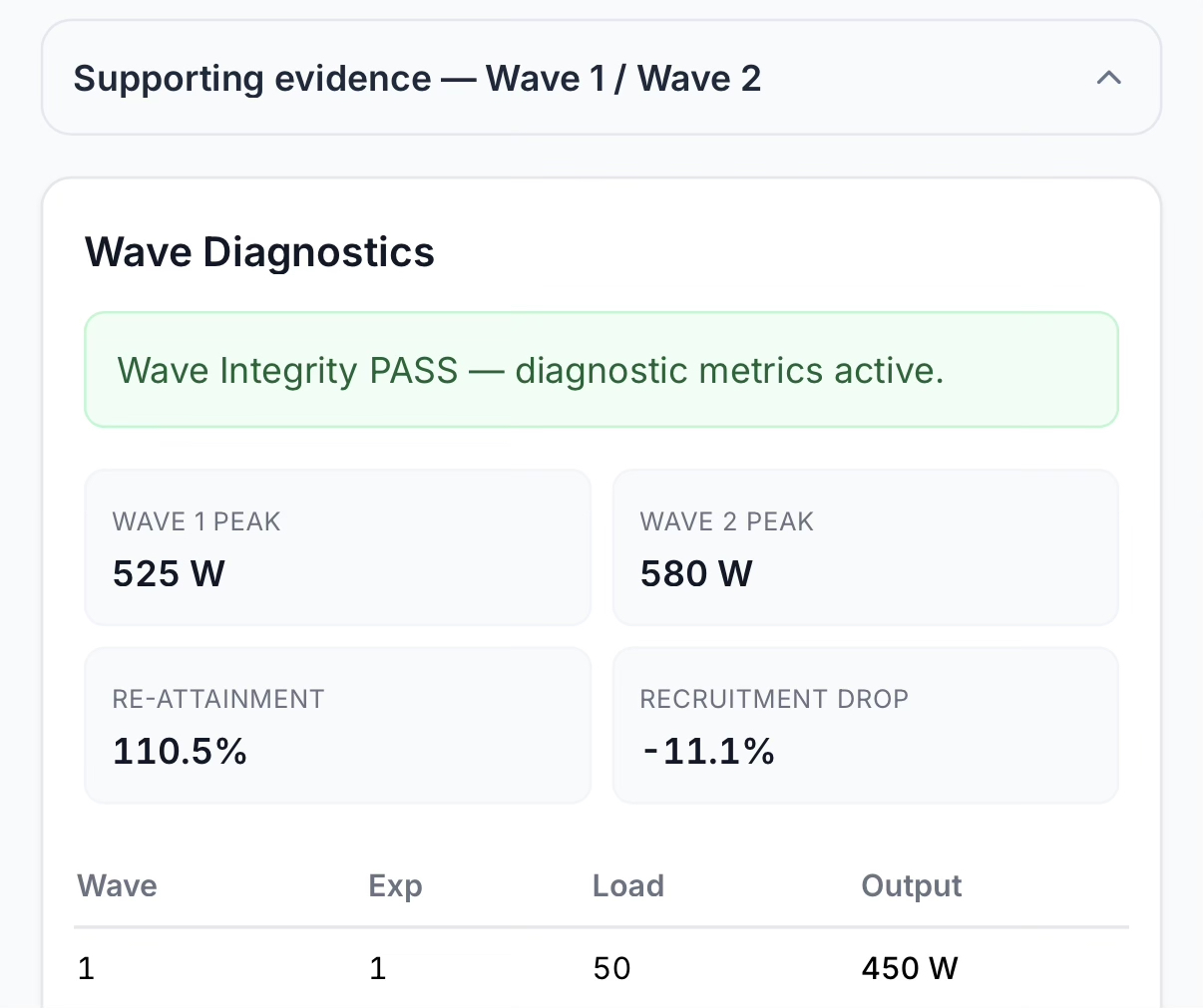
This is the problem I have been increasingly focused on through Evans Velo Zone®.
The objective is not to create another source of performance data.
It is to create a clearer developmental layer around information practitioners are already collecting.
That means moving beyond isolated testing and toward questions such as:
• What has been retained?
• What has changed?
• Where is the athlete now relative to where they were?
• What should the next training decision be?
Velocity-based training, force measurement, wellness monitoring, and other technologies can provide useful information about performance and training response.
The opportunity is to connect those measurements more explicitly to longitudinal developmental interpretation and decision-making.
Research on velocity-based training, for example, demonstrates the utility of objective performance feedback, while athlete-monitoring research continues to emphasize the importance of integrating different information sources into applied decisions (Włodarczyk et al., 2021; Burger et al., 2024). PubMed
Because ultimately, data becomes valuable when it improves what the practitioner does next.
The better question
Readiness still matters.
Practitioners need to understand an athlete’s current state, particularly when deciding how to manage training, fatigue, recovery, and performance demands.
But readiness and retention answer different questions.
Readiness tells us something about what the athlete can express now.
Retention tells us something about what development has endured.
And understanding both may give us a clearer picture of where the athlete actually is.
So the next time we evaluate an athlete, perhaps the question should not only be:
• “Are they ready today?”
We should also ask:
• “What have they actually kept?”
Steve Evans Jr., B.S., CSCS, USAW L2, TPI L2
Founder, Evans Velo Zone®
References
Bosquet, L., Berryman, N., Dupuy, O., Mekary, S., Arvisais, D., Bherer, L., & Mujika, I. (2013). Effect of training cessation on muscular performance: A meta-analysis. Scandinavian Journal of Medicine & Science in Sports, 23(3), e140–e149. https://doi.org/10.1111/sms.12047 PubMed
Burger, J., et al. (2024). Athlete monitoring systems in elite men's basketball: Challenges, recommendations, and future perspectives. Sports. PubMed
Hickson, R. C., & Rosenkoetter, M. A. (1981). Reduced training frequencies and maintenance of increased aerobic power. Medicine & Science in Sports & Exercise.
Note: the broader reduced-training evidence is summarized in Mujika & Padilla and related detraining literature. PubMed
Leduc, C., & Weaving, D. (2025). Invisible monitoring for athlete health and performance: A call for a better conceptualization and practical recommendations. International Journal of Sports Physiology and Performance. https://doi.org/10.1123/ijspp.2024-0292 PubMed
McMaster, D. T., Gill, N., Cronin, J., & McGuigan, M. (2013). The development, retention and decay rates of strength and power in elite rugby union, rugby league and American football: A systematic review. Sports Medicine, 43, 367–384. https://doi.org/10.1007/s40279-013-0031-3 PubMed
Mujika, I., & Padilla, S. (2000a). Detraining: Loss of training-induced physiological and performance adaptations. Part I: Short term insufficient training stimulus. Sports Medicine, 30(2), 79–87. https://doi.org/10.2165/00007256-200030020-00002 PubMed
Mujika, I., & Padilla, S. (2000b). Detraining: Loss of training-induced physiological and performance adaptations. Part II: Long term insufficient training stimulus. Sports Medicine, 30(3), 145–154. https://doi.org/10.2165/00007256-200030030-00001 PubMed
Saw, A. E., Main, L. C., & Gastin, P. B. (2016). Monitoring the athlete training response: Subjective self-reported measures trump commonly used objective measures: A systematic review. British Journal of Sports Medicine, 50(5), 281–291. https://doi.org/10.1136/bjsports-2015-094758 PubMed
Włodarczyk, M., Adamus, P., Zieliński, J., & Kantanista, A. (2021). Effects of velocity-based training on strength and power in elite athletes: A systematic review. International Journal of Environmental Research and Public Health, 18(10), 5257. https://doi.org/10.3390/ijerph18105257