From Athlete Evidence to Development Decisions: How EVZ™ Turns Performance Data Into Coaching Action
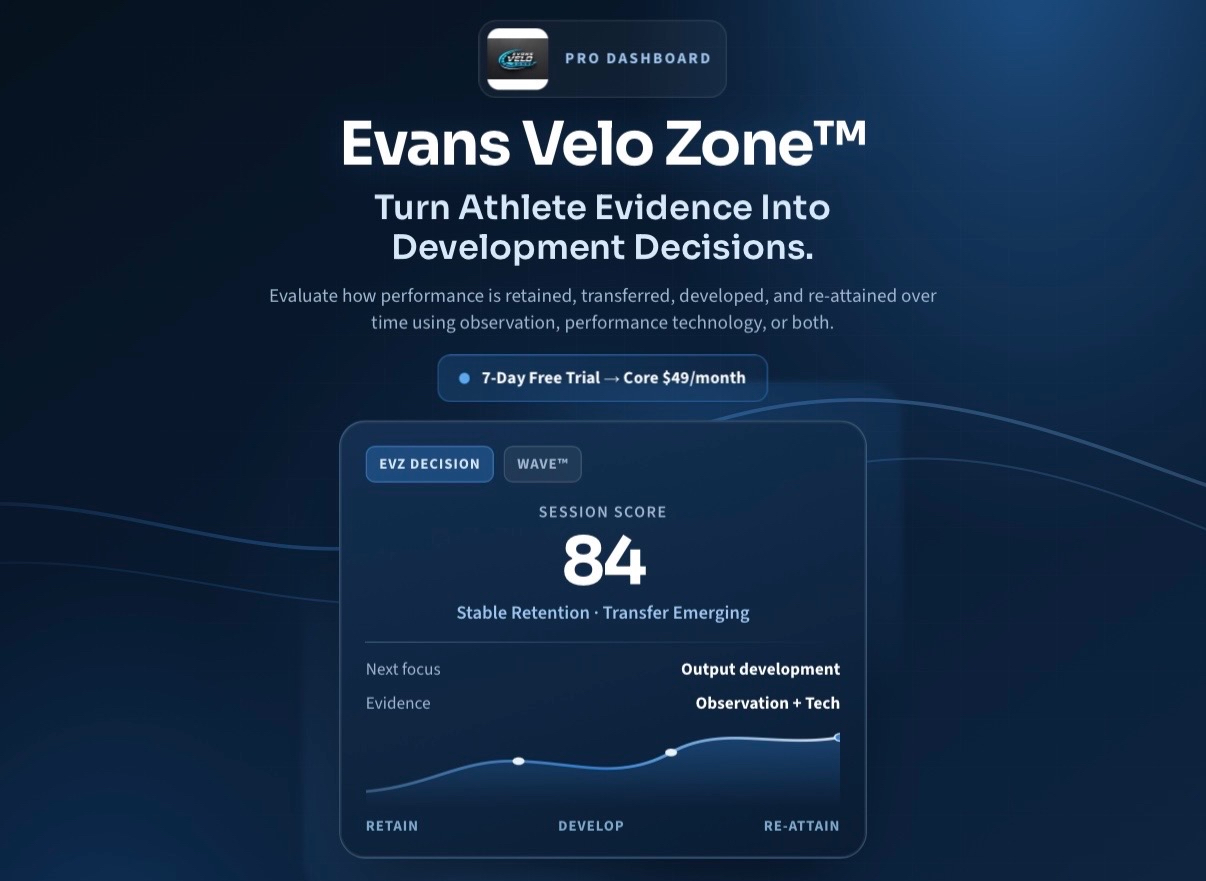
From Athlete Evidence to Development Decisions
Performance coaches have more information than ever.
Velocity. Power. Force. Timing. Video. Practitioner observation.
The challenge is no longer simply collecting evidence.
It is deciding:
• What does this evidence mean for the athlete—and what should happen next?
The Gap Between Measurement and Programming
A metric can tell a coach what happened.
It does not automatically determine whether the athlete needs to:
• stabilize performance
• adapt it to changing demands
• develop higher output
• or restore previously established performance
That requires developmental context.
Start With Intent
Before collecting data, the coach needs to know what the session is intended to develop.
EVZ organizes that intent around:
• Retention → Transfer → Output → Re-attainment
This creates a reference point for interpreting what follows.
Capture the Right Evidence
• Different training environments require different evidence.
Observation
• Structured practitioner assessment when technology is unavailable, unnecessary, or incomplete.
Technology
• Objective performance data such as velocity or power.
Hybrid
• Objective data interpreted alongside practitioner observation.
Different evidence. One developmental framework.
Interpret the Pattern
The important question is not simply:
• “Was the number good?”
It is:
• “What does this pattern suggest about the athlete’s current developmental priority?”
RPI™ can provide a retention/repeatability signal.
EVZ Wave™ can examine how performance responds across changing demands and whether an established profile can be re-attained.
The Development Profile places those findings within the broader athlete-development picture.
Make the Next Decision
Evidence becomes useful when it changes what happens next.
A coach may decide to:
• Maintain the current emphasis
• Adjust the demand
• Progress development
• Re-attain previously established performance
That is the transition from analytics to coaching.
Track the Outcome
The final question is:
• Did the decision work?
Longitudinal tracking allows the coach to compare intent, evidence, interpretation, recommendation, and subsequent performance over time.
The process becomes:
• Intent → Evidence → Interpretation → Decision → Outcome
The EVZ Perspective
EVZ does not replace the coach’s programming system.
It provides a structured layer for understanding what the athlete is showing and deciding what should be emphasized next.
Technology organizes the evidence.
EVZ provides the developmental logic.
Related EVZ Resources
Explore the EVZ Performance Platform →
Understand the Retainable Power Index (RPI™) →
Why Retention Is the Next Frontier in Performance Technology →
How EVZ Works With or Without Velocity Hardware →