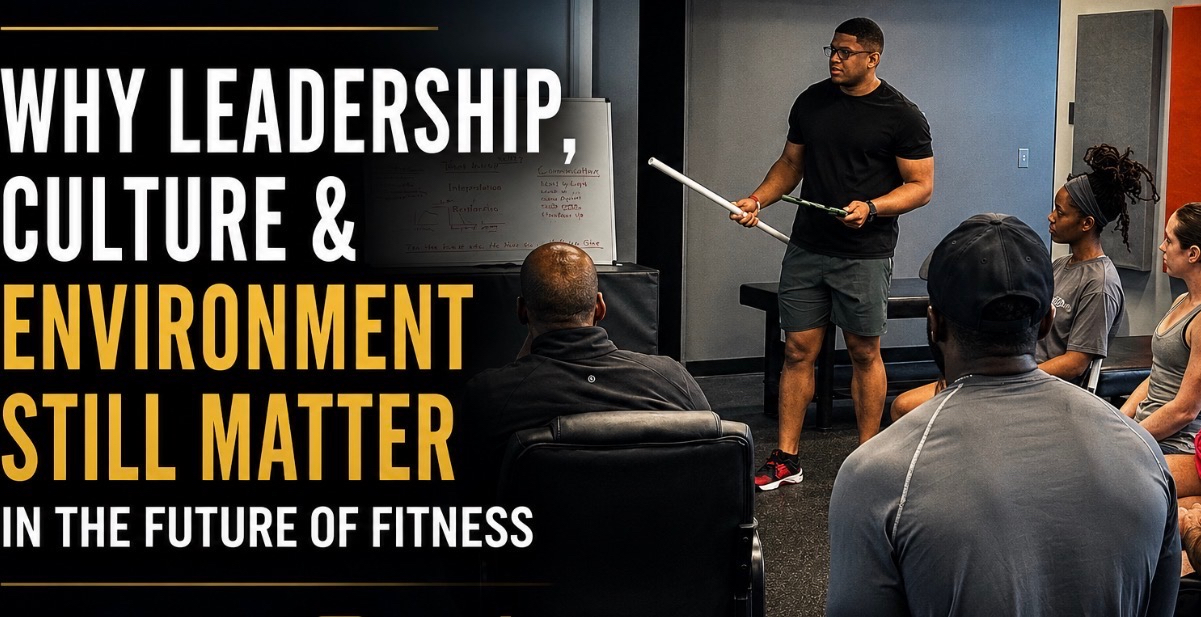
Why Leadership, Culture, and Environment May Be the Real Differentiators in the Future of Fitness
The Modern Fitness Industry Has More Resources Than Ever
The fitness industry has never had more technology, more data, more programming options, or more access to information.
At the same time, many organizations continue struggling with retention, staff turnover, burnout, operational inconsistency, and long-term sustainability.
⸻
Growth Alone Does Not Guarantee Sustainability
Recently, major fitness organizations such as Xponential Fitness have reported significant operational and financial strain despite massive scale, national brand recognition, marketing reach, and infrastructure. Public reporting has pointed toward declining same-store sales, leadership instability, operational challenges, heavy debt burden, profitability struggles, franchisee disputes, and declining investor confidence.
I think this highlights something important:
The future of fitness and performance may depend less on expansion volume and more on environment quality.
⸻
Why Some Environments Continue Thriving
Over the last 8 years managing and developing systems within the same multi-location performance company, I’ve had the opportunity to observe how operational consistency, staff development, communication, coaching quality, and culture directly influence long-term growth and retention.
During a time where portions of the fitness industry are experiencing contraction, our facility recently experienced 23% revenue growth alongside improved profitability and retention trends. While programming, branding, and equipment certainly matter, I do not believe those outcomes occur from programming alone.
They occur from ecosystem quality.
⸻
Ecosystem Quality vs Transactional Fitness
In my experience, sustainable environments are usually built around:
• clear leadership
• aligned staff development
• operational consistency
• accountability
• communication
• long-term relationship building
• psychologically sustainable environments for both staff and clients
This mirrors broader organizational culture literature surrounding leadership, communication, and long-term organizational stability (Schein, 2010).
The strongest coaching environments are rarely transactional. They are adaptive, communicative, developmental, and relationship-driven.
⸻
Durable Athletes and Durable Organizations
This mirrors many of the same principles I’ve been exploring through my work surrounding repeatable output, durable performance, and the Evans Velo Zone (EVZ) system.
In performance environments, isolated peak output means very little if the athlete cannot repeatedly express useful function under accumulated stress. Research in intermittent team sports has consistently demonstrated that performance output declines under accumulated fatigue conditions, particularly during repeated high-intensity efforts (Mohr, Krustrup, & Bangsbo, 2003).
I increasingly believe organizations operate similarly.
Many businesses can generate short-term output through aggressive expansion, high-volume acquisition, or rapid scaling. Sustaining quality, culture, staff stability, communication, and client trust over time is a completely different challenge.
⸻
The Hidden Variables Behind Long-Term Success
Durable organizations, much like durable athletes, are often built through:
• repeatability
• adaptability
• recovery
• communication
• intelligent workload management
• long-term developmental thinking
Similar concepts have been discussed extensively in performance literature surrounding sustainable adaptation and injury risk management (Gabbett, 2016).
Ironically, many of the variables that support long-term athletic development may also support long-term organizational stability:
• controlled progression
• environmental consistency
• behavioral alignment
• sustainable workload management
• recovery from accumulated stress
• clear communication systems
• strong leadership infrastructure
The environments that continue succeeding long term may not necessarily be the loudest, trendiest, or most technologically saturated. They may simply be the ones that consistently create trust, alignment, meaningful coaching, high-quality communication, and sustainable human interaction.
⸻
The Future of Fitness May Be Integrated Ecosystems
As fitness, wellness, recovery, and performance continue evolving, I believe the industry will increasingly move toward integrated ecosystems rather than isolated services.
The future may belong less to facilities selling workouts and more to environments capable of creating:
• longitudinal development
• sustainable behavior change
• integrated coaching
• repeatable outcomes
• high-trust experiences
• durable organizational culture
This type of long-term developmental framework increasingly aligns with broader athlete development models emphasizing progressive adaptation and longitudinal development pathways (Balyi & Hamilton, 2004).
⸻
Technology Should Support Interpretation, Not Replace It
Technology and data will continue playing an important role, but only when they improve interpretation, communication, decision-making, and environment quality rather than simply increasing metric volume.
⸻
Final Thoughts
Ultimately, leadership, culture, communication, and environment may still remain the most important infrastructure variables in performance.
Not only for athletes, but for organizations themselves.
⸻
References
Balyi, I., & Hamilton, A. (2004). Long-Term Athlete Development: Trainability in Childhood and Adolescence. Olympic Coach Magazine.
Gabbett, T. J. (2016). The training—injury prevention paradox: should athletes be training smarter and harder? British Journal of Sports Medicine, 50(5), 273–280.
Mohr, M., Krustrup, P., & Bangsbo, J. (2003). Match performance of high-standard soccer players with special reference to development of fatigue. Journal of Sports Sciences, 21(7), 519–528.
Schein, E. H. (2010). Organizational Culture and Leadership. Jossey-Bass.