Why Peak Performance Doesn't Guarantee Durable Performance
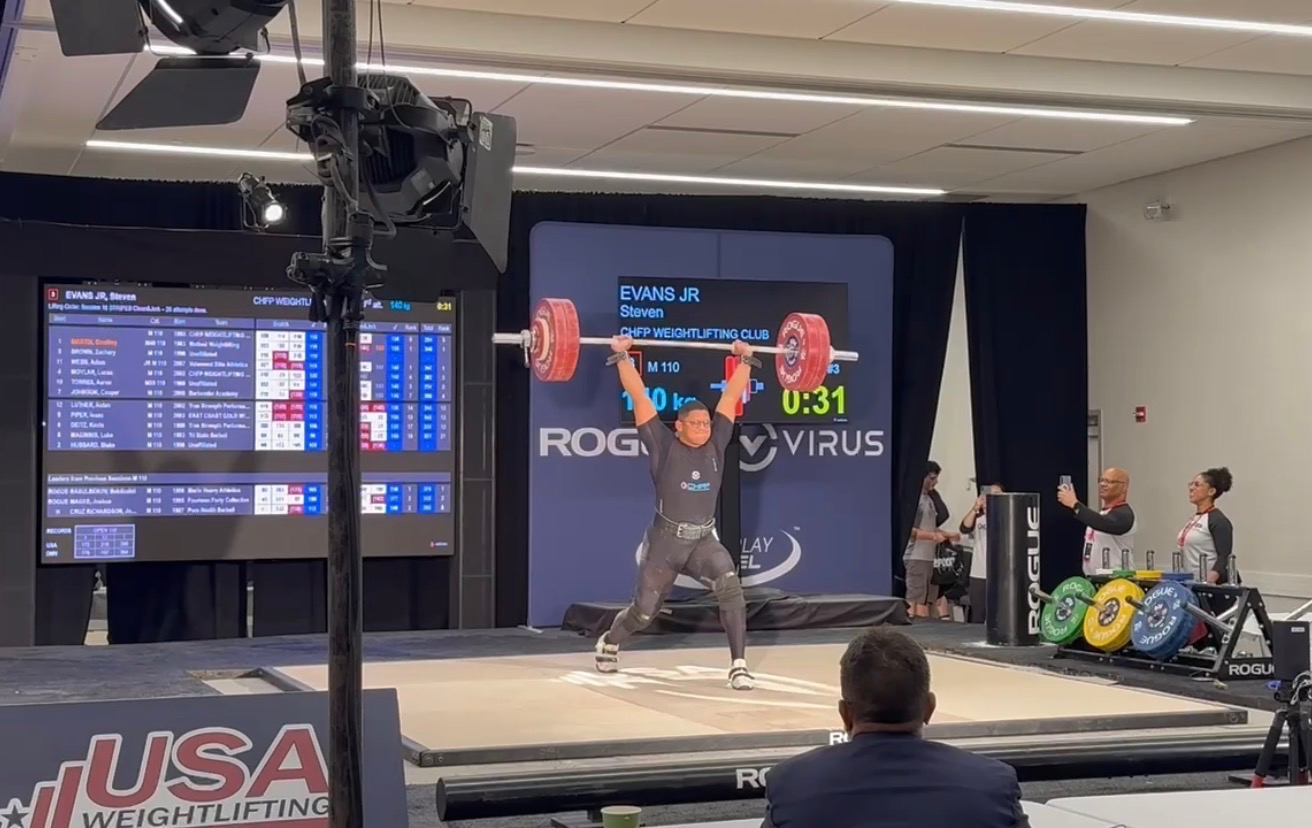
The Case for Power Retention in Sport Performance
Many athletes are getting stronger and more explosive than ever.
They jump higher, sprint faster, and produce impressive peak outputs in testing environments.
Yet in competition, performance often looks very different.
Power appears initially, and then disappears.
The athlete who looked explosive in testing suddenly struggles to reproduce that output across repeated efforts.
This raises an important question for coaches and performance professionals:
Is peak power actually what determines sport performance?
Or is something else quietly influencing whether explosive ability translates when it matters most?
⸻
The Missing Variable in Power Evaluation
In most strength and conditioning environments, explosive performance is evaluated through peak output by how:
• High an athlete can jump
• Fast a barbell can move
• Much force can be produced in a single effort
These numbers are useful and provide a snapshot of an athlete’s maximal potential, but they share a critical limitation:
They measure what happens once.
Sport rarely rewards isolated maximal efforts.
Instead, athletes must repeatedly express power across sequences of explosive actions:
• Repeated accelerations
• Consecutive jumps
• Multiple lifts
• Successive swings
• Ongoing reactive movements
As fatigue accumulates, power output often changes, sometimes dramatically.
This is where a different concept becomes important.
Power retention.
⸻
What Is Power Retention?
Power retention describes how well an athlete preserves output across repeated efforts.
Instead of asking:
“How high can the athlete jump once?”
We ask:
“How much of that output survives the second and third exposure?”
This distinction matters because sport is not an ideal peak environment.
Athletes rarely perform their most explosive movement in a perfectly fresh state. Instead, performance unfolds across sequences where fatigue, coordination, and neuromuscular efficiency interact.
If output collapses quickly across repeated exposures, the athlete may still appear powerful in testing environments while struggling to maintain performance when it matters most.
In simple terms:
Peak output reveals potential.
Power retention reveals durability.
👉🏾 Why Optimal Load is Incomplete Without Retention Mapping
⸻
Applying These Concepts in Practice
Many coaches intuitively recognize that explosive ability can fade across repeated efforts, but few have a structured way to measure or program for it.
The Evans Velo Zone™ framework was developed to evaluate how power behaves under repeated exposure by identifying whether an athlete’s explosive output is stable, degrading, or directionally limited.
This diagnostic approach is used to examine:
• Power retention across sets and exposures
• Re-expression patterns under fatigue
• Directional durability across movement patterns
• Transferability of explosive power to sport performance
For coaches interested in applying this framework in practice, these concepts are taught inside the Evans Velo Zone™ Practitioner Certification, where the full diagnostic model and programming strategies are explored.
Evans Velo Zone™ Practitioner Certification (Level I)
NSCA Approved Continuing Education Course (0.7 CEUs)
Founding cohort enrollment is currently open (Closes Monday, March 30th).
👉🏾 If you’re working with athletes and want to apply this directly, you can explore the EVZ Certification here.
⸻
Potential vs Transfer
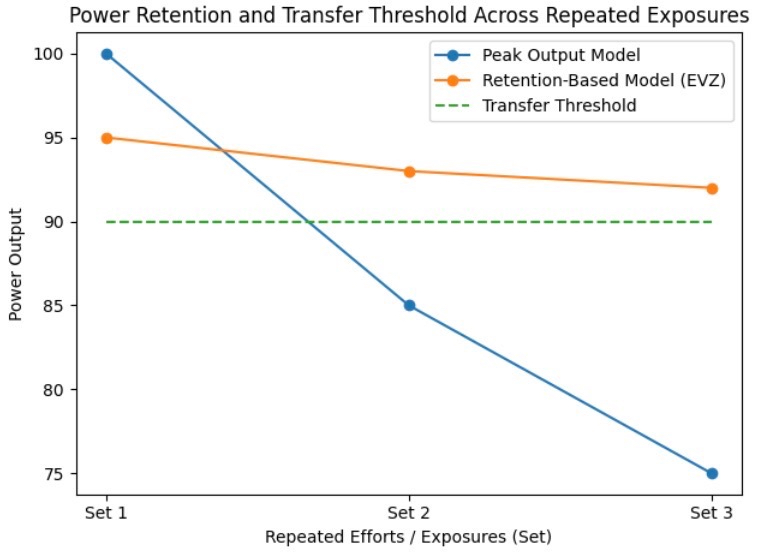
Consider two athletes who both produce a peak output of 100 units during an explosive movement.
Athlete A:
Set 1 — 100 watts
Set 2 — 85 watts
Set 3 — 75 watts
Athlete B:
Set 1 — 95 watts
Set 2 — 93 watts
Set 3 — 92 watts
Traditional peak testing would conclude that Athlete A is more powerful, but in real competition environments requiring repeated explosive actions, Athlete B’s profile is far more likely to produce stable performance.
The difference is not peak capability.
The difference is retention of output across exposure.
⸻
When Peak Power Misleads
A common assumption in strength and conditioning is that increasing maximal output will automatically improve sport performance.
In many cases, it does, but not always.
Athletes frequently improve their peak metrics without seeing equivalent improvements in competitive outcomes.
This phenomenon becomes clearer when we examine power retention patterns.
In a recent competition analysis, retention mapping helped explain why an Olympic weightlifter was able to produce a 6-for-6 competition result with personal records in both lifts.
Rather than chasing maximal peaks, the training process emphasized consistent heavy exposures and repeatable output.
You can explore that case study here:
👉🏾 Predictable Performance: How Prioritizing Power Retention and Transfer Produced a 6/6 Competition Result
That analysis illustrates how stable retention patterns can produce more reliable competition outcomes than isolated peak outputs.
⸻
Directional Retention: A Hidden Layer
Power retention is not always uniform across movement patterns.
Athletes may demonstrate strong retention in one direction while losing output rapidly in another.
This becomes especially relevant in rotational sports, where performance depends on coordinated force transfer across multiple vectors.
In a recent golf performance case study, a professional golfer demonstrated strong peak outputs across several movement patterns.
However, when repeated exposures were evaluated, lateral power showed reduced re-expression compared to vertical, horizontal, and rotational outputs.
This subtle difference suggested a directional durability limitation that could influence swing efficiency and performance stability.
You can read that analysis here:
👉🏾 Case Study: When Power Doesn’t Reappear — Diagnosing Lateral Re-Expression Deficits in a Professional Golfer
This example highlights how retention mapping can reveal performance limitations that traditional peak testing may overlook.
⸻
Expanding How We Evaluate Power
Peak output remains an important performance metric, but if our goal is to understand how explosive ability behaves in sport environments, evaluation models must expand.
Instead of focusing solely on:
• Maximal power
• Isolated velocity
• Single effort force production
We can begin examining:
• Retention across exposures
• Directional durability
• Re-expression patterns under fatigue
These variables help coaches understand whether power is simply present, or whether it is transferable and repeatable.
⸻
From Measurement to Application
Identifying retention patterns allows coaches to adjust training strategies.
Programming decisions can begin accounting for:
• Exposure sequencing
• Directional power development
• Fatigue tolerance
• Repeatability of explosive outputs
Over time, these adjustments can improve an athlete’s ability to sustain power across repeated efforts, which ultimately improves performance reliability in competition environments.
⸻
Implications for Coaches
Many programs successfully increase peak power.
Far fewer programs ensure that power survives repeated exposure.
Evaluating retention patterns helps coaches determine whether training is developing:
Isolated capacity
or
Transferable performance
This distinction is central to the Evans Velo Zone™ framework.
⸻
Applying the Evans Velo Zone™ Framework
For coaches interested in applying these concepts in practice, the Evans Velo Zone™ Practitioner Certification teaches the full diagnostic and programming system used to evaluate:
• Power retention
• Re-expression patterns
• Directional durability
• Transferable explosive performance
The certification translates these concepts into a structured evaluation framework used across multiple sports.
Evans Velo Zone™ Practitioner Certification (Level I)
NSCA Approved Continuing Education Course (0.7 CEUs)
Founding cohort enrollment is currently open.
👉🏾 Learn more about the certification
⸻
Rethinking Power in Sport
Peak power will always matter, but if we want to understand how explosive ability truly behaves in sport environments, we must also examine how that power survives repeated exposure.
In many cases, the difference between potential and performance lies not in how much power an athlete can produce once, but in how consistently that power can be reproduced when it matters most.
Power retention offers a framework for examining that difference.
And for coaches seeking to develop more reliable explosive performance, it may be one of the most important variables we have yet to fully explore.